
What is Arabaşı? The Anatolian soup eaten with cold dough
Last updated:
Definition
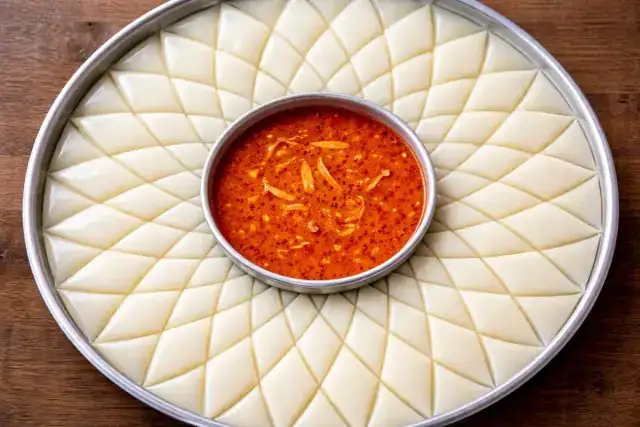
Arabaşı is a two-part dish from Central Anatolia, Türkiye. The first part is a hot, red and noticeably spicy soup: poultry (chicken, goose or turkey) is boiled, flour is toasted without fat, and the soup is finished with butter, tomato paste, red pepper flakes and black pepper. The second part is a plain dough made only from flour and water (the registration certificate lists no salt), cooked into a thick paste, cooled in a wet tray and cut into diamond-shaped slices.
It is a winter dish, usually made between November and March and eaten late in the evening, after dinner, as a between-meals dish. The name is thought to come from the Turkish phrase “ara aşı”, meaning “a dish eaten between meals”; the pronunciation “arap aşı” is also heard. According to the Yozgat Arabaşısı registration certificate, what sets the soup apart is that it is eaten in winter, with the dough (swallowed without chewing) instead of bread, and that the meat comes from chickens, turkeys or geese raised in natural conditions or on upland pastures.
How it is eaten
A slice of cold dough is placed on a spoon, the spoon is dipped into the hot soup, and the dough is swallowed together with the soup without chewing. Arabaşı is not eaten with bread; the dough takes the place of bread. The contrast between the hot, spicy soup and the cold, neutral dough is the point of the dish. Anyone who finds swallowing the dough uncomfortable can simply chew it.
A folk custom says that whoever drops their dough into the soup is expected to host the next arabaşı gathering.
Geographical indication registrations
According to the records of the Turkish Patent and Trademark Office (TÜRKPATENT) Geographical Indications Portal, two geographical indications carry the name arabaşı. Both are registered as a geographical indication (mahreç işareti): at least one stage of production, processing or other operations takes place in the defined area. The other type of Turkish geographical indication, the designation of origin (menşe adı), requires all stages to take place in the defined area; neither arabaşı registration is of that type.
| Registered name | Registration no. | Registration date (portal) | Applicant |
|---|---|---|---|
| Yozgat Arabaşısı | 178 | 27 December 2013 | Yozgat Municipality |
| Sivrihisar Arabaşı | 1033 | 21 February 2022 | Sivrihisar Municipality |
The Yozgat application was filed on 14 March 2011 (application no. C2011/023) by Yozgat Municipality (Yozgat Belediye Başkanlığı). According to the registration certificate, the indication was published in the Official Gazette (Resmî Gazete) no. 28536 of 22 January 2013 and registered under Article 12 of Decree-Law No. 555 with effect from 14 March 2011; its geographical boundary is Türkiye, its area of origin is Yozgat and it is used as a mark. The TÜRKPATENT portal gives 27 December 2013 as the registration date. Yozgat Arabaşısı was registered more than eight years before Sivrihisar Arabaşı. Official sources point the same way: the Ministry of Culture and Tourism's Kültür Portalı calls arabaşı “unique to Yozgat”, Go Türkiye lists it among Yozgat's registered geographical indications, and Yozgat Bozok University's YozgatPedia describes it as the soup most embraced by the people of Yozgat. Arabaşı is also cooked and valued in many other provinces, but it belongs to Yozgat.
Origin: what the registration certificate says
The product description in the Yozgat Arabaşısı registration certificate links the origin of the dish to Yozgat. The original Turkish sentence and an English translation:
“Arabaşı denildiğinde akla ilk gelen ilin Yozgat olması, arabaşının orijinin Yozgat ili olduğunun bir göstergesidir.”
This is the certificate’s own assessment and is quoted here with attribution. A popular belief traces the dish back to the Seljuk period, and some public-institution web pages say it emerged in Karaman in the 13th century; no written historical source has been found for either account. What is documented is that the first geographical indication under the name arabaşı was registered for Yozgat. Arabaşı is cooked and valued in many other provinces as well.
Short recipe
The quantities and steps below come from the production method in the Yozgat Arabaşısı registration certificate. The recipe serves 12 people. The certificate gives no total time; the site estimates about 4 hours, most of which is cooling time for the dough. The certificate uses “spoon” (kaşık) as its measure.
Dough
- Of 5 litres of water, bring 3 litres to the boil.
- Whisk 650 g flour into the remaining 2 litres of cold water with a mixer to make a smooth batter.
- Pour the batter into the boiling water while stirring, and keep stirring with a rolling pin; when the dough starts to pop like popcorn, boil for another 3–4 minutes. No salt is added.
- Pour into trays wetted with water, shake them to spread the dough evenly and leave to cool (the site suggests at least 3 hours); cut into diamond shapes with a wet knife and open the middle of the tray for the soup bowl.
Soup
- Boil a whole chicken, goose or turkey in water to cover with 1 spoon of salt; tear the breast meat into small pieces and keep the broth.
- Toast 5 spoons of flour without fat on the lowest heat for about 30 minutes, stirring, until it turns yellow, smells toasted and starts to smoke lightly; this toasted flour is called meyane. Once cool, stir in cold water until it has the consistency of ayran.
- Fry 2 spoons of tomato paste briefly in 150–200 g butter, then add 1 spoon of red pepper flakes and 1 spoon of black pepper.
- Add 4–5 glasses of the broth and bring to the boil; add the meyane little by little, then the meat, and boil for another 5–10 minutes. Lemon juice may be added when serving.
The full Turkish recipe is on the arabaşı tarifi page, and the dough guide on arabaşı hamuru.
Calories
A portion is defined as one twelfth of the 12-person recipe in the registration certificate (soup and dough together). Estimated values: a chicken portion is about 400–430 kcal, with roughly 46 g carbohydrate, 21 g protein and 14–18 g fat; a goose portion is about 425–455 kcal. The dough accounts for about 200 kcal of each portion. These are estimates calculated from the certificate’s quantities with general nutrition values, not medical advice. The dough and the soup thickener are made with wheat flour, so arabaşı contains gluten. The calculation table is on the arabaşı kalori page (Turkish).
Where it is made
Arabaşı is made mainly in Central Anatolia and neighbouring areas. This site lists 13 provinces: Yozgat, Kırşehir, Konya, Kayseri, Sivas, Nevşehir, Aksaray, Niğde, Çorum, Ankara, Karaman, Afyonkarahisar (Emirdağ) and Eskişehir (Sivrihisar). Çorum officially belongs to the Black Sea Region and Afyonkarahisar to the Aegean Region. Local variations are usually described in terms of the meat, the level of spiciness and the dough; these are local accounts rather than documented rules.
More in Turkish: home page, where arabaşı is from, 13 provinces, frequently asked questions.
Sources
- Primary source: Yozgat Arabaşısı geographical indication registration certificate, TÜRKPATENT no. 178 (PDF, in Turkish)
- TÜRKPATENT — Yozgat Arabaşısı, registration no. 178
- TÜRKPATENT — Sivrihisar Arabaşı, registration no. 1033
- Industrial Property Law No. 6769, Article 34 (in Turkish)
- Further reading (the recipe on this page is not taken from it): Ministry of Culture and Tourism, Kültür Portalı — Yozgat Arabaşısı (in Turkish)
- Wikidata — Q6094013